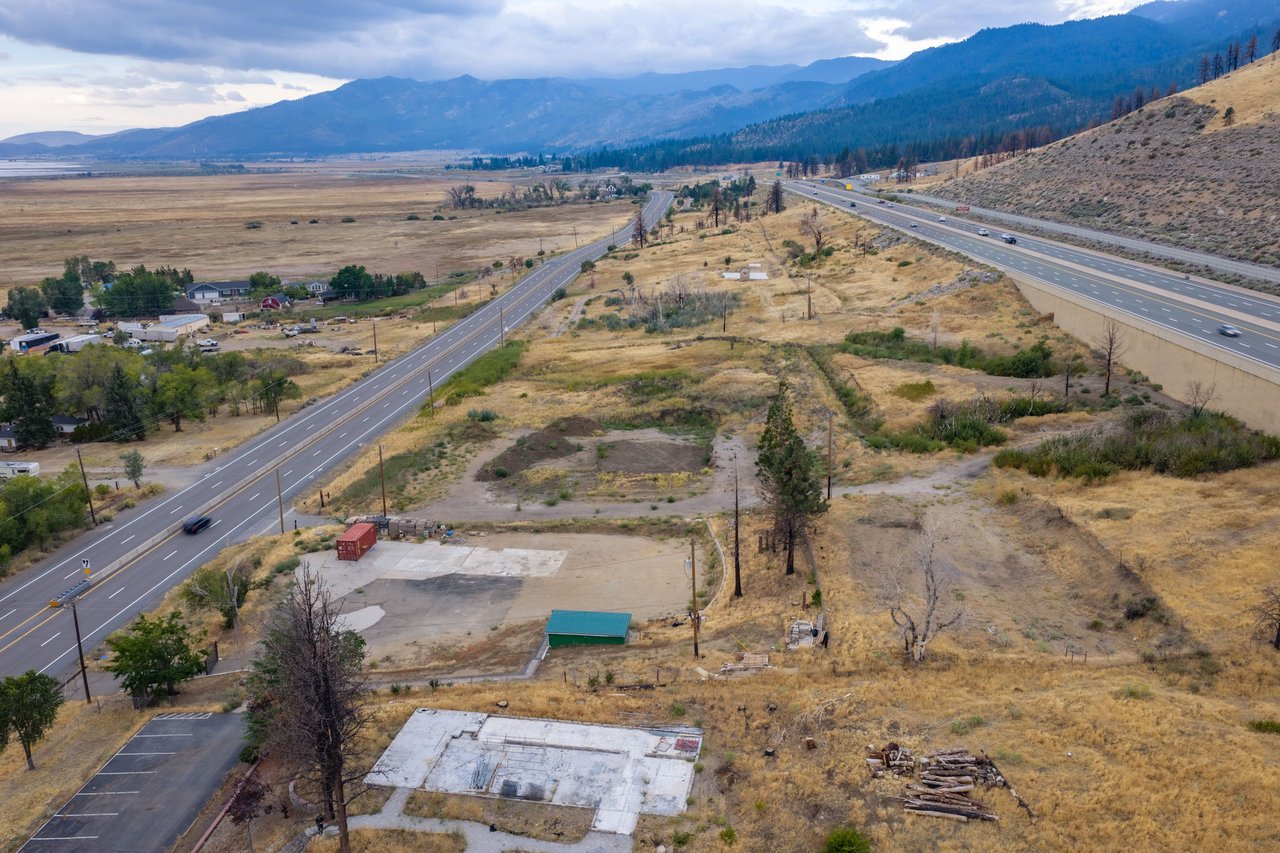
Every year, the stretch of Interstate 80 between Vista Boulevard and USA Parkway logs more than 150 crashes, according to the Regional Transportation Commission of Washoe County. That's roughly one every other day, on the same nine miles that carries nearly every worker commuting from Sparks and Spanish Springs out to the Tahoe-Reno Industrial Center. If you're comparing a home in Sparks to one in Reno right now, that road is doing more to explain the price difference than square footage, school zones, or curb appeal ever will.
Buyers scanning listings usually read the Sparks-Reno gap as a straightforward trade: pay less, get more space, live a few minutes farther from downtown. That's true as far as it goes. But the size of that gap, and how durable it is, has less to do with the homes themselves than with a single, overloaded highway corridor that connects the region's biggest job engine to the neighborhoods building the most new housing to serve it.
What the Gap Actually Looked Like Recently
In June 2026, the Northern Nevada Regional MLS reported a median single-family sale price of $710,000 in Reno, up 6.0 percent from a year earlier. Sparks came in at $590,000, up 5.9 percent. Both cities were moving fast: Reno homes went under contract in a median of 11 days, Sparks in 20, and both markets sat below two months of supply, well under the four-to-six-month range that usually signals balance.
| Metric (June 2026) | Reno | Sparks |
|---|---|---|
| Median sold price | $710,000 | $590,000 |
| Year-over-year change | +6.0% | +5.9% |
| Median days to contract | 11 | 20 |
| Months of supply | 1.8 | 1.6 |
A month later, the picture wobbled. Reno's median climbed again to $715,000, a new high for the year. Sparks slipped to $562,500, down almost 5 percent from June, a shift the reporting team attributed to a thinner pool of closings that month rather than a change in direction. Zoom out to a different data provider tracking the same week in July and you'll find a Sparks-Reno gap of roughly $55,000 instead of $150,000, because that source uses a different sample and averaging method entirely.
That inconsistency is worth sitting with for a second. In a market this tight, with sub-two-months supply and homes moving in under three weeks, a stable price gap between two adjacent cities usually means something structural is holding it in place, not just seasonal noise. The exact number moves depending on which month and which data source you check. The reason a gap exists at all does not.
One Job Engine, One Road In
Nine miles east of Reno and Sparks on I-80 sits the Tahoe-Reno Industrial Center, a 107,000-acre business park whose main entrance is the USA Parkway interchange. The park itself has no residential zoning: nobody lives inside TRIC. Everyone who works there commutes in.
Tesla and Panasonic together employ an estimated 11,000 people directly at the Gigafactory, with the broader supplier network pushing total EV-ecosystem employment in the region to somewhere between 25,000 and 30,000, according to reporting compiled earlier this year. Wages span a wide range, from roughly $48,000 for entry-level production associates up past $130,000 for engineers and $250,000-plus for senior leadership, with an average across all positions around $70,000, comfortably above the county's typical household income. That wage floor is high enough to qualify a lot of buyers for a lot of mortgages, and it's concentrated a nine-mile drive from Sparks.
In testimony to state lawmakers in 2025, Sparks officials put a number on where those workers actually live: roughly 80 percent of the TRIC workforce lives in Reno or Sparks, and four out of five of those workers live north of I-80, in the Spanish Springs corridor that also happens to be where most of the region's new-construction housing is going up. That's not a coincidence. It's the market matching the newest, most affordable inventory to the workforce closest to the jobs. It's also exactly the population most exposed to a single, congested highway with no alternate route.
The Fixes Are Real, But None of Them Are Fast
The state has acknowledged the bottleneck. NDOT secured a $250 million federal grant to widen I-80 between Vista Boulevard and USA Parkway, but that project isn't expected to finish before 2031. Separately, the RTC completed a feasibility study for a new roadway, the Northeast Connector, linking Sparks and Spanish Springs directly to TRIC through the Pah Rah Range, with the Vista Boulevard alignment near Golden Eagle Regional Park emerging as the preferred route. The RTC's own project page lists that study's planning phase as spring 2026, with environmental review, design, and construction all still marked "to be determined."
A few other ideas are circulating alongside it:
- Sparks officials have asked state lawmakers for authority to build Nevada's first toll road along a Spanish Springs-to-USA Parkway alignment, a request that would still need legislative approval before it goes anywhere.
- The RTC floated a feasibility study for commuter rail using existing Union Pacific track between the Reno Amtrak station and TRIC.
- Conservation advocates have flagged that the connector's preferred route runs through land proposed for protection under the Truckee Meadows Public Lands Management Act, adding a layer of environmental review that could slow any construction timeline further.
None of this means relief isn't coming. It means a buyer weighing Sparks against Reno today shouldn't price in a fix that's realistically five-plus years out and still contested on multiple fronts.
What the New-Construction Premium Actually Buys
If you're shopping new construction in Sparks specifically, the numbers get more interesting. As of mid-July 2026, Sparks had 57 active new-construction listings built in 2024 or later, carrying a median list price of $700,000, about 21 percent above the city's overall active median of $579,000. Stonebrook alone accounted for 21 of those 57 listings, with builders like Toll Brothers active across several collections within the master plan, and Wingfield Springs and the broader Spanish Springs valley close behind.
That premium buys current Sierra snow-load and energy code, a statutory 1/2/10 warranty, and a lot in whichever master plan anchors the northeast Truckee Meadows for the next decade. It does not buy a second road. Some of these newer communities also carry special improvement district or limited improvement district assessments layered on top of standard HOA dues, which is worth confirming line by line before you fall for a model home. A new build in Stonebrook and a resale in central Sparks both funnel through the same nine miles of I-80 to reach TRIC. The construction date on the house changes nothing about the road underneath it.
Not All of Sparks Carries the Same Exposure
It's worth separating the TRIC-commuter growth corridor from what's happening in downtown Sparks itself, because the two tell different stories. Victorian Square, the city's historic downtown district, has been adding housing that has nothing to do with the industrial park commute. The Bridges, a 194-unit apartment project with ground-floor retail, opened near the district's parking garage several years ago, and The Atrium added another 132 units nearby. Silverwing Development's broader plan for the area called for more than 1,500 housing units over five to seven years alongside new retail and the renovated Galaxy Theatre, reshaping downtown Sparks into a walkable district built around its own casinos, restaurants, and events rather than a commute out to USA Parkway.
If you're comparing a downtown Sparks condo to a Reno unit, the I-80 bottleneck barely enters the equation. If you're comparing a Stonebrook single-family home to something in Reno's Somersett or Damonte Ranch, it should be near the top of your list of questions, right alongside the mortgage payment.
What This Means If You're Choosing Between the Two
The practical takeaway isn't that Sparks is a bad buy. Homes there are moving in 20 days at 99 percent of list price, which is not a market in trouble. The takeaway is that the discount you're seeing, whatever exact figure the data shows this month, is compensation for a specific, named risk: dependence on a single congested highway to reach the region's largest employment cluster, with the state's own timeline putting meaningful relief past 2031.
If your household's commute runs out toward TRIC, price that risk in before you price the house. If it doesn't, and you're looking at Sparks for its own downtown, its schools, or simply its distance from Reno's Midtown congestion, the calculation looks entirely different. Either way, the number on the listing is only half the story. The other half is nine miles of asphalt with no detour.
If you're weighing Reno against Sparks and want a comparison built around your actual commute and price range rather than a citywide average, Kirsch Real Estate Team can walk you through what's really moving in each corridor right now. Request a private consultation or start with a free home valuation to see where your numbers land.
FAQ
Is Sparks still a good value compared to Reno? By most current readings, yes on price. Sparks homes have sold at a meaningful discount to Reno through the first half of 2026 while still moving fast, under three weeks to contract with sale-to-list ratios near 99 percent. The value case gets stronger or weaker depending on whether your daily commute runs through the Vista Boulevard-to-USA Parkway corridor.
When will the Sparks-to-TRIC commute actually improve? The only funded, dated project is NDOT's I-80 widening between Vista Boulevard and USA Parkway, targeted for completion around 2031. The Northeast Connector and any toll road or rail options remain in early planning or proposal stages with no confirmed construction date.
Does the price gap between Reno and Sparks stay consistent month to month? No. Different data sources and even the same source in different months have shown the gap ranging from roughly $55,000 to $150,000. Treat any single month's figure as a snapshot, not a fixed rule, and ask for a comparative market analysis specific to the neighborhood and price point you're targeting.