Fed Rate Increase: What It Means for Reno Mortgage Rates and the Housing Market
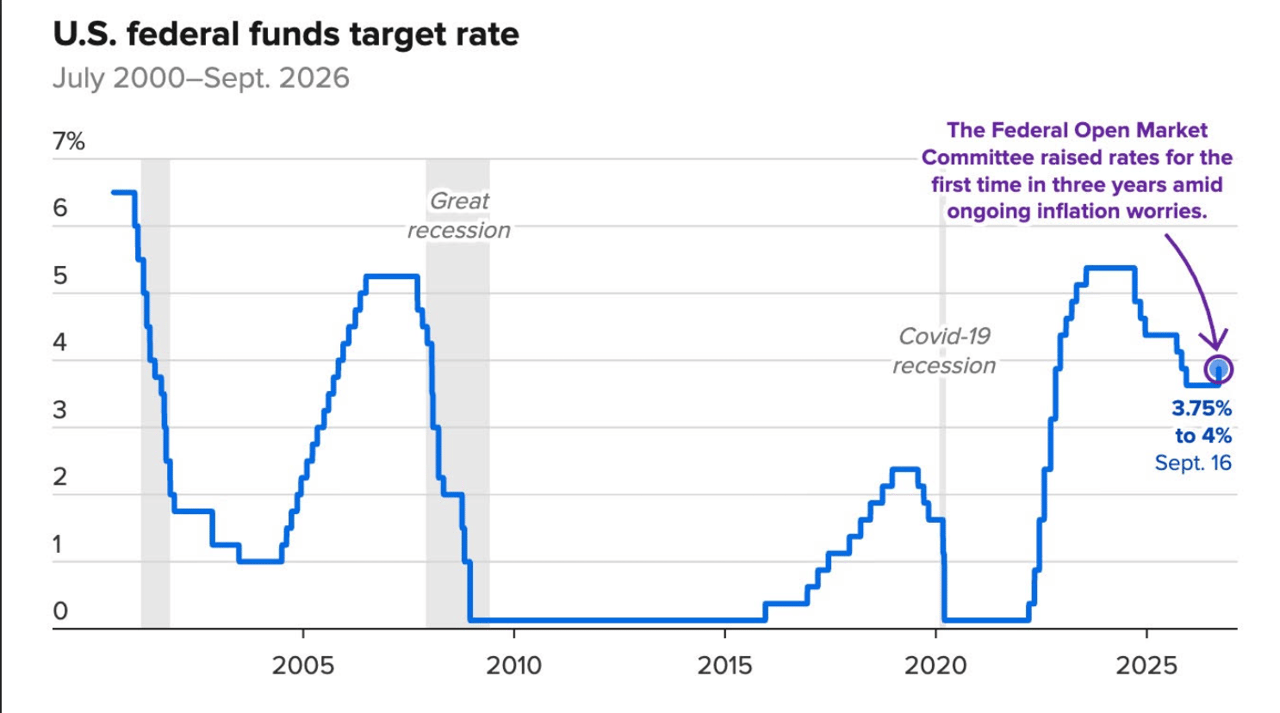
The Federal Reserve raised its benchmark interest rate by 0.25 percentage points at its September 2026 meeting, marking its first rate increase since 2023. The move brings the federal funds target range to 3.75%–4.00% and signals that the Fed remains focused on controlling inflation.
What does the Federal Reserve interest rate increase mean for mortgage rates, Reno home prices, and anyone thinking about buying or selling a home in Northern Nevada?
The Quick Answer
The Federal Reserve does not directly set mortgage rates, but its decisions affect the broader financial markets that influence them. Mortgage rates had already moved above 7% before the Fed’s announcement as markets anticipated the increase.
The Fed also indicated that another rate increase may be possible before the end of 2026. That does not guarantee mortgage rates will continue rising, but it makes a dramatic near-term decline less likely.
For Reno homebuyers, the best strategy may be to negotiate around the monthly payment through seller credits and interest-rate buydowns instead of waiting indefinitely for lower rates.
For Reno home sellers, accurate pricing, strong presentation, and financing incentives are becoming increasingly important.
What Did the Federal Reserve Decide in September 2026?
At the conclusion of its September 15–16 meeting, the Federal Reserve increased its benchmark rate by 0.25 percentage points.
The Fed made the decision because inflation remains above its long-term 2% target. Although the economy and employment market have remained relatively resilient, the Fed has not seen enough evidence that inflation is moving toward its goal quickly enough.
The Fed’s latest projections also suggest that policymakers may approve one more rate increase before the end of the year.
This is important for real estate because expectations about inflation and future Federal Reserve policy influence Treasury yields, mortgage-backed securities, mortgage rates, construction financing, and consumer confidence.
Does a Fed Rate Increase Make Mortgage Rates Go Up?
Not automatically and not always immediately.
The Federal Reserve controls the federal funds rate, which is the overnight rate banks charge one another. Mortgage rates are more closely connected to the bond market, inflation expectations, and the yield on the 10-year U.S. Treasury.
Mortgage rates often move before a Fed meeting because financial markets attempt to anticipate what the Fed will do next. By the time the September decision was announced, average 30-year mortgage rates had already climbed above 7%.
This means the Fed did not simply “add 0.25%” to everyone’s mortgage rate. Much of the anticipated increase may have already been reflected in mortgage pricing.
The larger issue for buyers and sellers is the Fed’s overall message: inflation remains a concern, and policymakers are not signaling immediate relief from higher borrowing costs.
What Does the Fed Rate Increase Mean for Reno Homebuyers?
The biggest challenge for Reno homebuyers continues to be affordability.
Higher mortgage rates increase the monthly payment associated with a particular home price. A buyer may qualify for less than anticipated, or a home that appeared affordable several months ago may now require a larger down payment or different financing strategy.
However, waiting for rates to drop is not automatically the safest or least expensive choice.
If mortgage rates remain elevated, waiting may not produce the savings a buyer expects. If rates decline significantly, more buyers could reenter the market simultaneously, potentially increasing competition for the best homes and putting upward pressure on prices.
Instead of trying to predict the exact direction of mortgage rates, buyers should focus on the parts of the transaction they can control:
- The purchase price
- Seller-paid closing costs
- Temporary or permanent interest-rate buydowns
- Loan type and down payment
- Property taxes and homeowners insurance
- HOA fees and assessments
- The home’s condition and anticipated repair expenses
- The possibility of refinancing if rates decline later
Every buyer should work with a knowledgeable lender to compare the actual monthly payment under several scenarios before writing an offer.
Is a Seller-Paid Rate Buydown Better Than a Price Reduction?
In some situations, yes.
A price reduction sounds appealing, but a modest reduction may only make a small difference in the monthly mortgage payment. Applying the same amount toward a temporary or permanent interest-rate buydown can sometimes create more meaningful short-term payment savings.
For example, a seller credit could potentially be used to reduce the buyer’s interest rate, cover closing costs, or preserve the buyer’s cash for improvements after closing. The best use of that credit depends on the loan program, the buyer’s financial goals, and how long the buyer expects to own the home.
This is why negotiations in the current Reno housing market should involve more than the purchase price. The structure of the offer can be just as important as the number written at the top.
Seller contributions are subject to loan-program limits, so buyers should confirm the allowable amount and structure with their lender before submitting an offer.
Should Reno Buyers Wait for Mortgage Rates to Fall?
There is no universal answer.
Waiting may make sense if the current monthly payment is uncomfortable, a buyer’s employment situation is changing, or the buyer needs more time to save. No one should purchase a home based on the assumption that refinancing will definitely be available later.
However, a financially prepared buyer who finds the right home and expects to own it for several years may have opportunities in a market with fewer competing buyers.
Buying during a higher-rate environment can sometimes provide:
- Less competition
- More negotiating leverage
- Greater opportunity for seller credits
- More time to complete inspections and due diligence
- A better selection among homes that have spent longer on the market
If mortgage rates improve later, refinancing may become an option. If rates do not improve, the buyer has still purchased at a payment that was reviewed and considered affordable from the beginning.
The right question is not simply, “Are rates high?” It is, “Does this particular home and payment make sense for my finances and long-term plans?”
What Does the Fed Decision Mean for Reno Home Sellers?
The Fed’s decision reinforces the importance of pricing a home correctly from the beginning.
Buyers are still purchasing homes throughout Reno, Sparks, Spanish Springs, South Reno, Verdi, Montreux, and the surrounding Northern Nevada communities. However, many are more selective because monthly payments have increased.
A home that is overpriced may sit longer, even if it has an attractive location or desirable upgrades. Extended market time can eventually lead buyers to assume there is something wrong with the property or that the seller will accept a steep discount.
Sellers should consider several strategies:
- Price the home based on current competing listings and recent sales
- Prepare the property carefully before it reaches the market
- Address obvious maintenance issues
- Use professional photography and strong digital marketing
- Offer a buyer closing-cost or rate-buydown credit when appropriate
- Review feedback and showing activity quickly
- Adjust the strategy if the market does not respond
In today’s market, the strongest listing strategy combines correct pricing, excellent presentation, broad online exposure, and terms that recognize the buyer’s financing concerns.
Will Reno Home Prices Fall Because Interest Rates Increased?
A Fed rate increase does not automatically cause home prices to fall.
Mortgage rates are only one factor affecting the Reno housing market. Local home prices are also influenced by:
- The number of homes available for sale
- Local employment and household income
- Population and migration trends
- New-home construction
- Buyer demand within each price range
- The availability and cost of developable land
- The condition, location, and uniqueness of individual properties
Northern Nevada also has many homeowners with substantial equity and low existing mortgage rates. Some owners are reluctant to sell a home financed at 3% or 4% and replace it with a new mortgage at a much higher rate.
This “rate-lock effect” can restrict the number of homes offered for sale. Lower demand may place pressure on prices, but limited inventory can provide support.
The result may be a continued affordability stalemate rather than a dramatic decline: buyers are cautious about higher payments, while many potential sellers are reluctant to give up their existing loans.
Real estate conditions also vary considerably by neighborhood and price point. The market for a luxury home in Montreux may behave very differently from the market for an entry-level home in Reno or Sparks.
Are Cash Buyers in a Stronger Position?
Cash buyers and purchasers making substantial down payments may have additional leverage while mortgage rates remain elevated.
Cash buyers are less directly affected by rate changes and may face less competition from financed buyers. They may also offer sellers greater certainty and fewer financing-related contingencies.
That does not mean every cash offer should be substantially below market value. Well-priced and highly desirable homes can still attract multiple interested buyers.
However, cash can become particularly valuable when a seller prioritizes certainty, flexibility, or a shorter closing timeline. This is especially relevant in Reno’s luxury, investment, and second-home markets.
What Does This Mean for New Construction?
Higher interest rates affect builders as well as individual buyers.
Builders rely on financing to acquire land, develop communities, and construct homes. Higher borrowing costs can make future projects more expensive and may slow the pace of new construction.
At the same time, builders with completed inventory may offer incentives to attract buyers. Depending on the community and builder, those incentives could include:
- Mortgage-rate buydowns
- Closing-cost assistance
- Design-center credits
- Appliance or landscaping packages
- Price reductions on completed homes
Buyers comparing new construction with resale homes should evaluate the total cost, not just the advertised interest rate or incentive. Property taxes, lot premiums, HOA fees, special assessments, landscaping costs, window coverings, and post-closing improvements can significantly affect the final expense.
How Should Reno Buyers and Sellers Respond?
The latest Federal Reserve meeting should not create panic, but it should affect strategy.
Buyers should:
- Obtain an updated preapproval
- Request current payment estimates
- Discuss rate-lock options with their lender
- Compare price reductions with seller-paid rate buydowns
- Avoid relying on a future refinance to make the payment affordable
- Look for properties where they may have negotiating leverage
Sellers should:
- Review the newest comparable sales and active competition
- Price for the current market—not the market from several years ago
- Prepare the home before listing
- Consider offering financing incentives
- Track showings and buyer feedback closely
- Respond quickly if the initial strategy is not working
Frequently Asked Questions
Did the Federal Reserve raise interest rates in September 2026?
Yes. The Federal Reserve raised its benchmark interest rate by 0.25 percentage points at its September 15–16, 2026 meeting, bringing the target range to 3.75%–4.00%.
Did mortgage rates immediately increase by 0.25%?
No. The Fed does not directly set mortgage rates. Mortgage rates are influenced by Treasury yields, inflation expectations, mortgage-backed securities, economic data, and expectations about future Federal Reserve policy.
What are mortgage rates after the September Fed meeting?
Mortgage rates vary by lender, borrower qualifications, loan program, down payment, property type, and market conditions. Average 30-year rates had already risen above 7% before the announcement. Buyers should request a current quote from a lender rather than relying on a national average.
Will mortgage rates go down in 2026?
Mortgage rates could move in either direction. The Fed’s indication that another increase may occur makes a substantial near-term decline less certain. Future mortgage rates will depend heavily on inflation, employment data, Treasury yields, and investor expectations.
Is now a bad time to buy a home in Reno?
Not necessarily. Buyers face higher financing costs, but they may also encounter less competition and greater negotiating leverage. The decision should be based on the buyer’s monthly payment, financial stability, expected ownership period, and the value of the particular property.
Should a buyer ask for a price reduction or a rate buydown?
It depends on the buyer’s loan and goals. A rate buydown may create greater monthly savings, while a price reduction lowers the purchase price and loan balance. A lender can compare both options using the same dollar amount.
Will Reno home prices decline because of the Fed rate increase?
A rate increase may reduce buyer demand, but home prices also depend on local inventory, employment, population trends, construction, and seller behavior. Conditions can differ substantially among Reno neighborhoods and price ranges.
Is it still a good time to sell a home in Reno?
A properly priced and well-marketed home can still sell successfully. Sellers should expect buyers to be highly focused on value, condition, and monthly affordability. Pricing and negotiation strategy matter more in a higher-rate environment.
The Bottom Line for the Reno Housing Market
The Federal Reserve’s September 2026 rate increase does not mean the housing market is stopping. It does mean buyers and sellers should prepare for mortgage rates to remain elevated and potentially volatile.
Buyers should focus on the complete monthly payment and explore creative negotiations, including seller credits and rate buydowns. Sellers should price accurately, present their homes exceptionally well, and consider incentives that directly address affordability.
Most importantly, national interest-rate headlines do not affect every property equally. Real estate is local. The market for a home in South Reno, Montreux, Spanish Springs, Verdi, or central Reno can vary based on inventory, condition, price point, and buyer demand.
If you are considering buying or selling a home in Reno, Sparks, or Northern Nevada, the Kirsch Team can help you evaluate the latest market activity, understand your options, and build a strategy around your specific goals.
About Laura Kirsch: Laura Kirsch is a Reno-based residential real estate professional and team leader with more than $350 million in career sales. She and the Kirsch Team represent buyers and sellers throughout Reno, Sparks, Montreux, South Reno, Spanish Springs, Verdi, and the surrounding Northern Nevada communities.
Sources: Federal Reserve, September 2026 FOMC announcement and economic projections; Associated Press coverage of the September 2026 Federal Reserve decision; current mortgage-market reporting as of September 2026.
This article is for general informational purposes only. Mortgage rates, loan availability, and borrower qualifications vary. Buyers should consult a licensed mortgage professional regarding their specific financing options.